
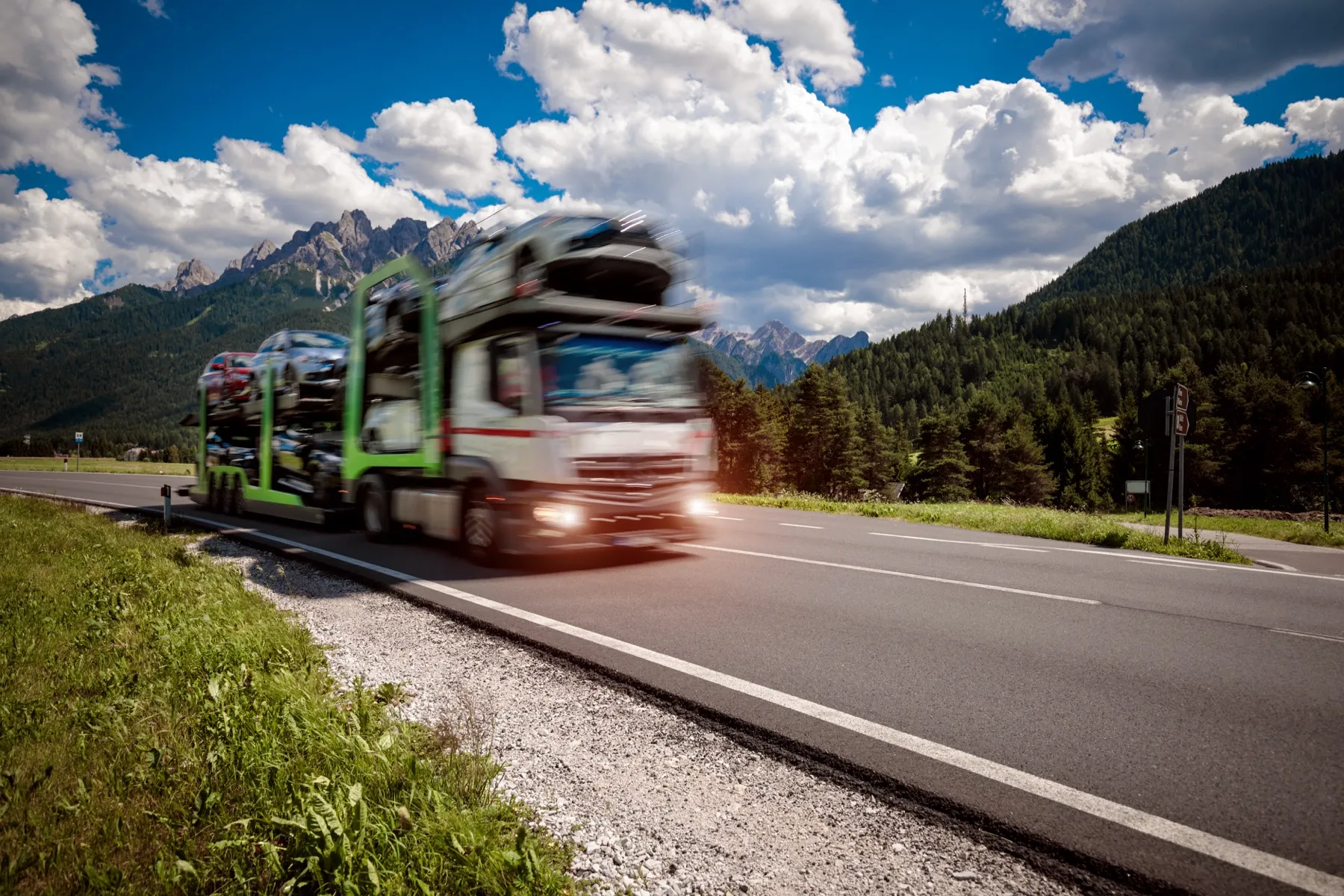
Hungary is a long drive from the Channel, and people worry about handing a car to strangers for the whole of it. Our own enclosed transporter makes regular runs through Europe, so the car can come all the way from Hungary to our site with us. Then we clear it, convert it and register it.
- Usual method
- Road transport, ferry or container
- Price
- Priced per job
- Transit time
- Usually 1 to 4 weeks door to door
- Import tax
- 20% VAT, no duty if EU or UK-built
How the car gets here
We collect the car in Hungary and deliver it to our premises in Castle Donington. Our enclosed euro-transporter travels through Europe regularly, which keeps the car covered for the trip. If you would rather drive it over yourself, we clear it through UK customs once you land.
Door to door, European moves usually take 1 to 4 weeks, depending on collection and customs. Our guide to how long shipping takes explains what moves the date.
The Hungarian side
In Hungary, vehicle registration is handled by the government offices, the kormányhivatal, and you deal with them through the kormányablak desks. A car leaving Hungary for good comes off the Hungarian register, and this is the step to get right.
The exact steps, documents and fees are set by the Hungarian office, not by us, so ask them before the car leaves. Tell them it is going to the UK, which is outside the EU, and ask what they need from you and what they hand back.
Keep the Hungarian registration certificate. We need the car's registration document to register it in the UK, so make sure you leave the office with it or with whatever they issue in its place.
Import tax from Hungary
Hungary is in the EU, so a car from there usually pays 20% import VAT on the price plus transport. There is no duty if it was built in the EU or UK. That covers a good number of cars actually made in Hungary, such as the Suzuki Vitara, the Audi A3 saloon and the Mercedes-Benz CLA.
A Hungarian-registered car built outside the EU and UK pays 10% duty on top. A car over 30 years old pays 5% VAT and no duty. VAT is worked out on the invoice, or a recent valuation if the invoice is more than 3 months old. The import tax calculator gives a rough figure.
If you have lived outside the UK for over 12 months and owned the car for over 6, you may import it tax and duty free under Transfer of Residence, through an HMRC application. A car that was UK-registered before may come back tax free with its UK purchase invoice and a copy of its old V5C; see bringing a UK car back home.
The whole job, in order
-
Before it leaves
Check with the government office
Ask the kormányablak what taking the car off the Hungarian register involves, and keep the registration document.
-
Transit
Our transporter
We collect in Hungary on our enclosed euro-transporter, or you drive the car over.
-
Arrival
Customs and NOVA
As HMRC CDS authorised agents we make the customs entry, avoiding storage fees, and tell HMRC through NOVA.
-
Preparation
Changes and testing
Headlights, mph speedometer and rear fog light, then the approval route that fits the car’s age.
-
Within 10 working days
DVLA registration
Our dealer-level DVLA account lets us register imported cars within 10 working days.
Customs and NOVA
We handle customs clearance ourselves as HMRC CDS authorised agents, so the car does not sit building up storage fees. HMRC must be told within 14 days that it has arrived, through the Notification of Vehicle Arrivals (NOVA). The DVLA will not register it without that, and we file it as part of clearance.
Changes for UK roads
Hungarian cars are left-hand drive and set up for driving on the right. Before registration they need:
- Headlight beam pattern changed so it does not dazzle oncoming traffic
- A speedometer that shows mph
- A rear fog light, if the car does not already meet UK rules
We do this work on our own site. Our guide to speedometer and headlight conversions covers how, and left-hand drive cars in the UK covers driving one here.
Testing and registration
Cars under 10 years old must meet UK type approval. For an EU-built car that usually means a Certificate of Conformity, which we can source. Without one, the car takes an IVA test on our private lane, which also handles MOTs.
- Under 10 years old: a Certificate of Conformity or an IVA test
- Over 10 years old: type approval exempt, but an MOT and the usual changes
- Over 40 years old: no MOT, and the car can be delivered to your UK address before registration
We run one of only seven privately operated IVA centres in Great Britain. If the car is already in the UK, it can often be registered remotely, or brought to us for the work it needs.
Your Hungary paperwork
0 of 6 done
What it costs
Hungary is priced per job. Where the car is, whether it rides on our transporter or you drive it, and what it needs here all change the figure. The estimator covers the tax side.
For what every EU route shares, see importing a car from Europe, or the Hungary country page.
Questions people ask
How do you bring a car from Hungary to the UK?
Usually on our own enclosed euro-transporter, which travels through Europe regularly. We collect the car in Hungary and deliver it to our site. You can also drive it over and we clear it at this end.
How long does it take?
Door to door, European moves usually take 1 to 4 weeks, depending on collection and customs.
How do I take the car off the Hungarian register?
Through the government office (kormányhivatal), at a kormányablak desk. The steps and fees are theirs to set, so ask them before the car leaves and keep the registration document.
Do I pay import tax on a car from Hungary?
Usually 20% import VAT on the price plus transport, with no duty if it was built in the EU or UK. Transfer of Residence can make it tax and duty free if you are moving here.
Does a Hungarian car need an IVA test?
Under 10 years old it needs a Certificate of Conformity or an IVA test, both of which we handle. Over 10 years old it needs an MOT, and over 40 years old no MOT.
Bringing a car over from Hungary? Send us the details on the quote form.
